FALAS Blog
Constitutional reform is one of the most consequential exercises in any democracy. It shapes the distribution of power, strengthens governance institutions, and determines how citizens participate in the political process. In Sierra Leone, discussions surrounding structurally sensitive constitutional reforms have become increasingly significant as the nation continues to pursue democratic consolidation, institutional resilience, and accountable governance.
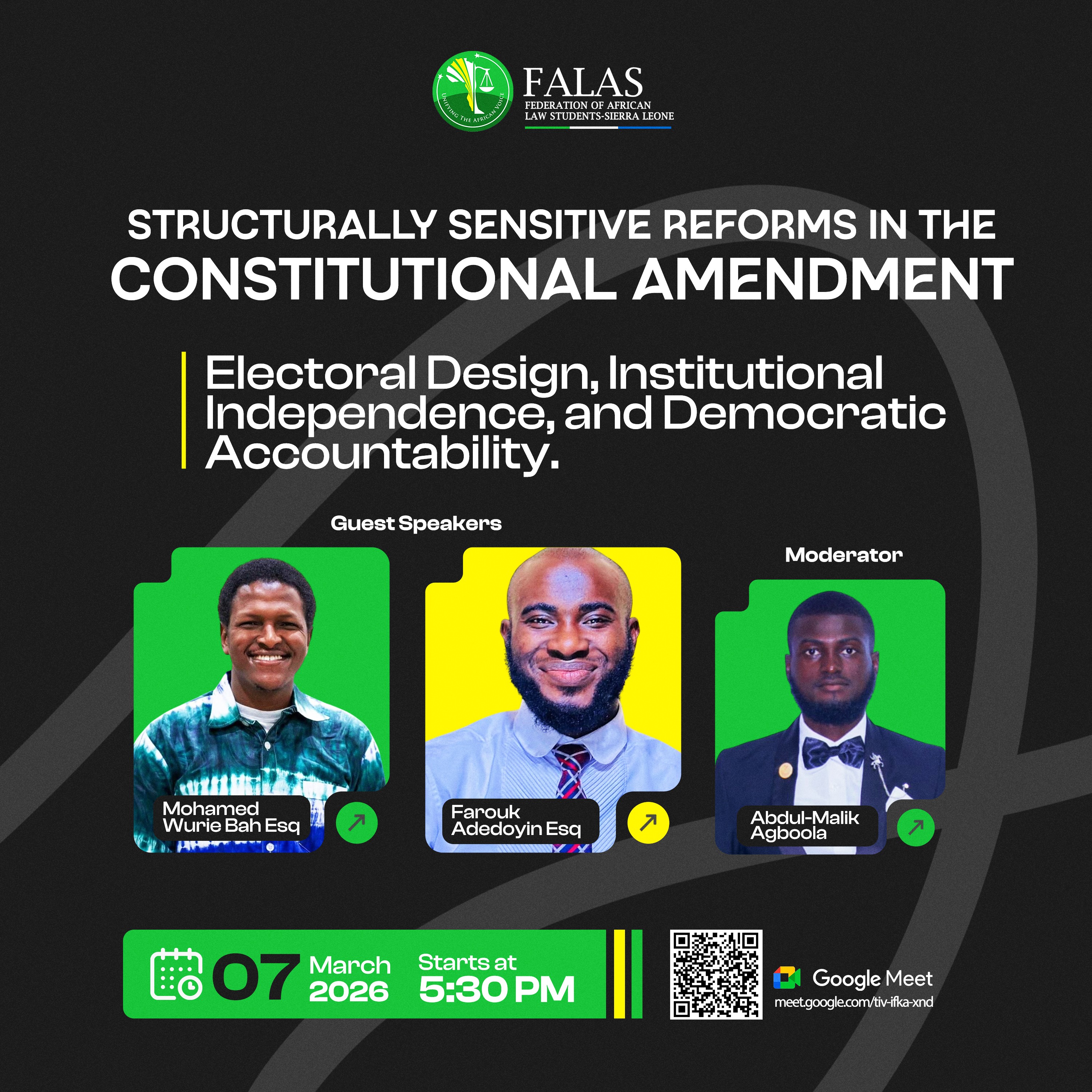
Recognizing the importance of informed legal discourse on these issues, the Federation of African Law Students (FALAS) – Sierra Leone successfully hosted an engaging virtual webinar on 7 March 2026, bringing together legal experts, students, and governance enthusiasts to examine the constitutional amendment process and its implications for Sierra Leone's democratic future.
Webinar Theme
Structurally Sensitive Reforms in the Constitutional Amendment: Electoral Design, Institutional Independence, and Democratic Accountability
The webinar explored how constitutional amendments influence the country's electoral framework, the autonomy of key democratic institutions, and the systems that ensure transparency, accountability, and the rule of law.
The discussion encouraged participants to critically assess whether proposed constitutional reforms adequately protect democratic principles while responding to Sierra Leone's evolving political and legal landscape.
Expert Perspectives
The webinar featured insightful presentations from distinguished legal professionals with expertise in constitutional law and governance.
Mohamed Wurie Bah, Esq.
Mohamed Wurie Bah examined the constitutional foundations of electoral governance and highlighted the importance of designing electoral systems that promote fairness, inclusivity, and public confidence. His presentation emphasized that constitutional reforms should strengthen electoral integrity rather than create opportunities for political manipulation.
Farouk Adedoyin, Esq.
Farouk Adedoyin focused on the principle of institutional independence, stressing that democratic institutions—including electoral bodies, oversight agencies, and accountability mechanisms—must remain insulated from political interference. He underscored that constitutional safeguards are essential for preserving public trust and ensuring the effective administration of justice.
Moderation
The session was expertly moderated by Abdul-Malik Agboola, who guided the discussion through key constitutional questions, encouraged audience participation, and facilitated a dynamic exchange between the speakers and participants.
The moderation ensured that complex constitutional concepts were presented in an accessible manner while maintaining the depth expected in legal and policy discussions.
Key Areas of Discussion
Throughout the webinar, several critical issues emerged as central themes:
The constitutional principles guiding electoral reform.
Balancing constitutional flexibility with democratic stability.
Safeguarding the independence of constitutional commissions and oversight institutions.
Strengthening democratic accountability through effective constitutional mechanisms.
Comparative lessons from constitutional reform processes across Africa.
The role of law students and emerging legal professionals in promoting constitutional literacy and civic engagement.
Participants also examined the legal implications of constitutional amendments and the need for reforms that reflect both international democratic standards and Sierra Leone's unique constitutional context.
Interactive Engagement
The webinar attracted a diverse audience of law students, legal practitioners, academics, and civic-minded citizens. The interactive question-and-answer session enabled participants to engage directly with the speakers on issues ranging from electoral system design to constitutional checks and balances.
The exchange of ideas demonstrated the growing interest among young legal professionals in understanding constitutional governance and contributing meaningfully to national policy conversations.
Strengthening Democratic Governance
A recurring message throughout the webinar was that constitutional reform should not be viewed merely as a legal exercise but as a democratic process that requires transparency, public participation, and careful consideration of long-term national interests.
The speakers emphasized that structurally sensitive reforms must reinforce institutional independence, promote electoral credibility, and enhance democratic accountability rather than concentrate power or weaken constitutional safeguards.
Looking Ahead
The successful webinar reaffirmed FALAS Sierra Leone's commitment to advancing legal education and fostering informed discussions on constitutional development and democratic governance.
By creating a platform where experienced legal practitioners and aspiring lawyers could engage in thoughtful dialogue, the event contributed to a deeper understanding of the constitutional amendment process and its impact on Sierra Leone's democratic institutions.
As the country continues to navigate constitutional reform, conversations such as these remain essential in ensuring that legal changes are grounded in the principles of justice, accountability, constitutionalism, and the rule of law. Through continued engagement, education, and civic participation, the next generation of legal professionals will play a vital role in shaping a constitutional framework that protects democratic values and serves the interests of all Sierra Leoneans.